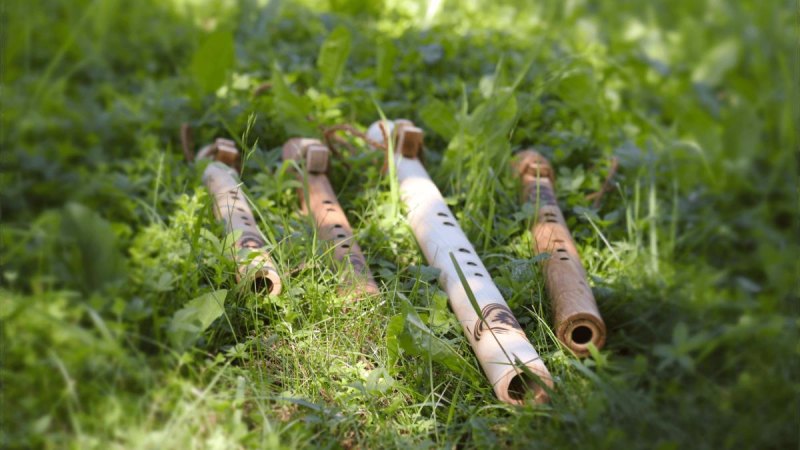
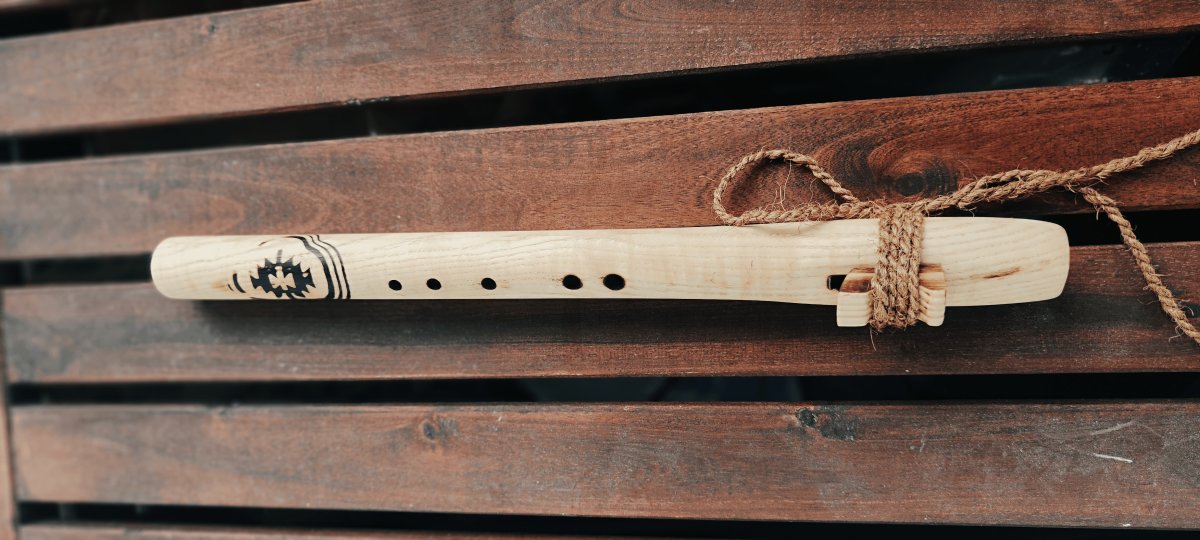
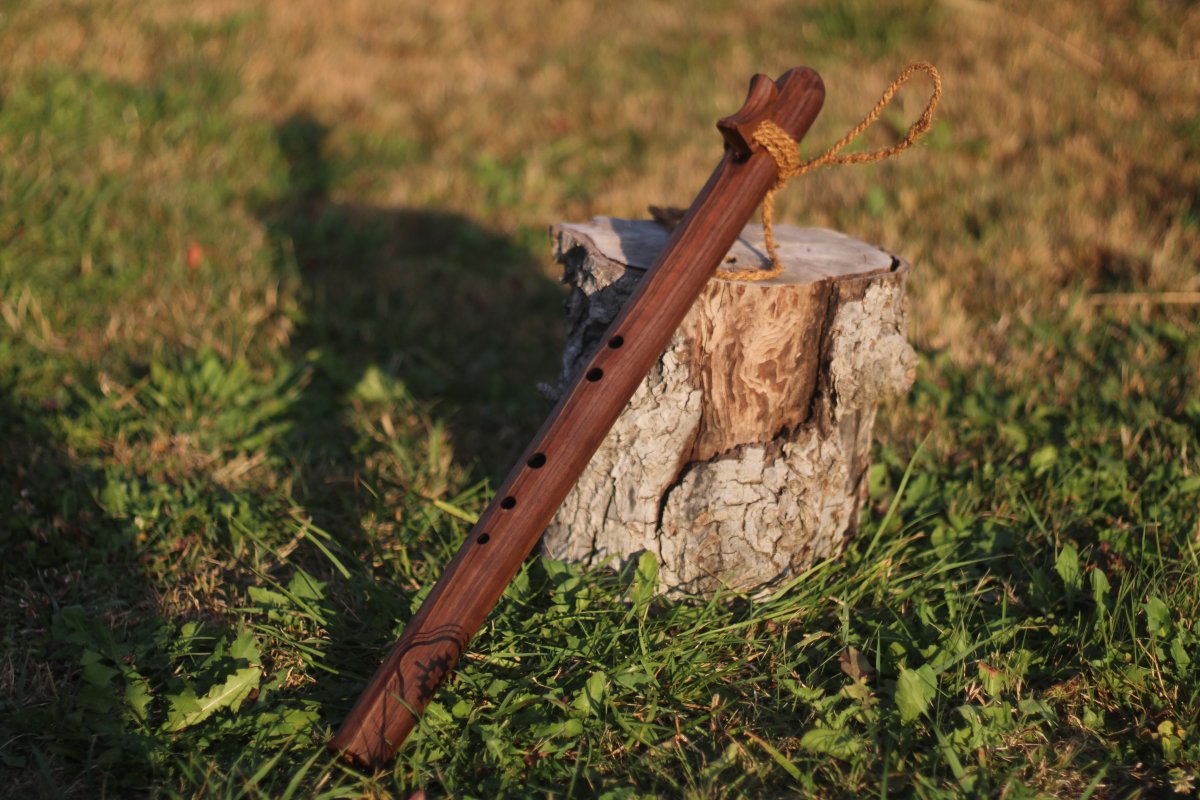
Lakota Lullaby is the first song I tab for every flute I make. It uses only six of the seven notes on a 5-hole flute, every phrase fits in one breath, and the whole song is under a minute. Below is the complete song as I play it on my Low E flute: the six notes with their fingerings, every phrase with its notes and lyrics, and a free PDF tab that matches the video note for note.
Download the free PDF tab (2 pages, with lyrics and translation)
The full lesson: 0:00 the song, 0:14 the six notes, 0:26 phrase by phrase, 1:14 the whole song to play along. Chapters are in the video's description.
The six notes
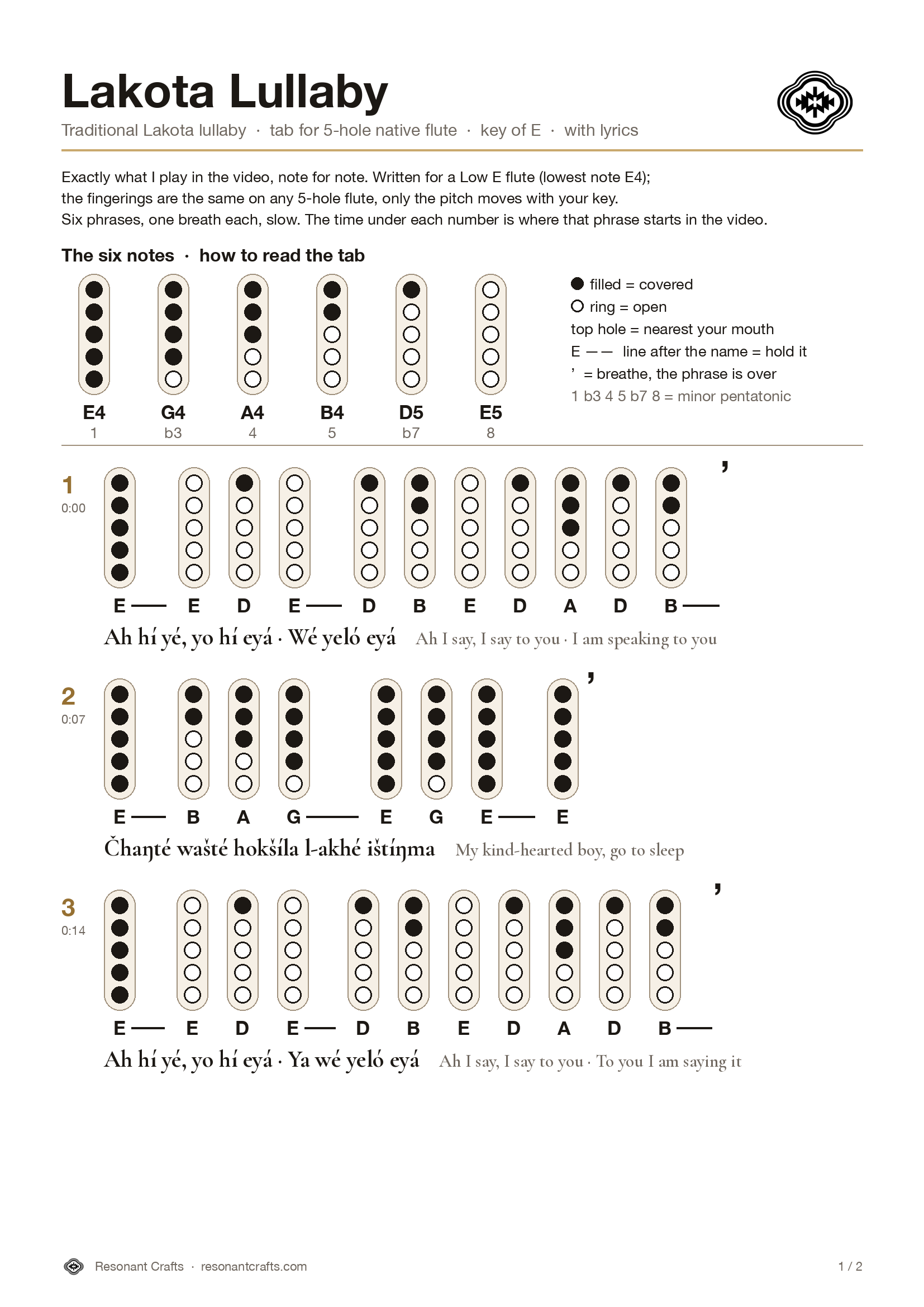
Hold the flute with the top hole nearest your mouth. A filled circle is a covered hole, a ring is an open hole. The letters are for an E flute; on any other 5-hole flute the fingerings are exactly the same, only the pitch moves with your key.
| Note | Holes (top to bottom) | Scale degree |
|---|---|---|
| E (low) | ● ● ● ● ● | 1, the root |
| G | ● ● ● ● ○ | b3 |
| A | ● ● ● ○ ○ | 4 |
| B | ● ● ○ ○ ○ | 5 |
| D | ● ○ ○ ○ ○ | b7 |
| E (high) | ○ ○ ○ ○ ○ | 8, the octave |
Two things to practise before the song. First, the octave jump from the low E to the high E: all five fingers lift at once and the air gets a little faster. Not harder, faster. If the high E cracks, you are blowing too hard. Second, the move between D and the high E: only the top finger moves, everything else stays open.
How to read the tab
Each row of the tab is one phrase and one breath. Above every flute glyph is the note name, below the row is the Lakota line and its English translation. The time at the start of each row is where that phrase begins in the video, so you can jump straight to the phrase you are working on. Long notes are written once; hold them as long as the lyric needs.
Phrase by phrase
Six phrases, and only three different shapes. Phrases 1 and 3 are the same, phrases 2 and 5 start the same way, and phrase 6 is the ending. Learn phrase 1 and phrase 2 and you already have most of the song.
Phrase 1 · 0:00
E · E high · D · E high · D · B · E high · D · A · D · B
Ah hí yé, yo hí eyá · Wé yeló eyá — Ah I say, I say to you · I am speaking to you
Start on the low E with all holes covered, then lift everything for the high E. From there the melody rocks between D and the high E: only the top finger goes down and up. The phrase ends on B, two holes covered.
Phrase 2 · 0:07
E · B · A · G · E · G · E · E
Čhaŋté wašté hokšíla l-akhé ištíŋma — My kind-hearted boy, go to sleep
A walk down the scale: B, A, G, E, one finger closing at a time. Close the holes fully, a small leak on the way down makes the note sound thin. The last two E's are the same note played twice: a light touch of the tongue separates them.
Phrase 3 · 0:14
E · E high · D · E high · D · B · E high · D · A · D · B
Ah hí yé, yo hí eyá · Ya wé yeló eyá — Ah I say, I say to you · To you I am saying it
The same notes as phrase 1. If the first one worked, this one works.
Phrase 4 · 0:21
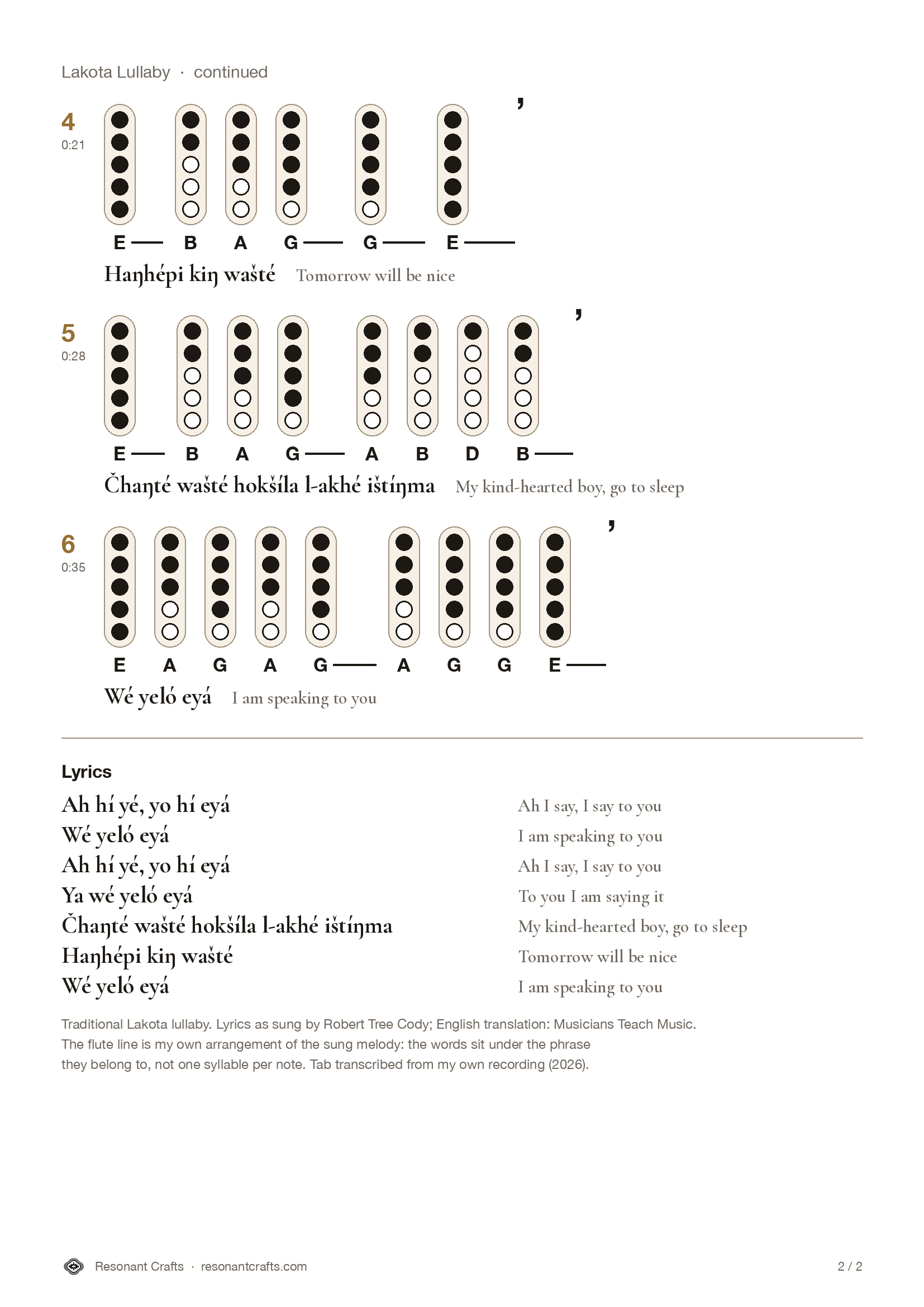
E · B · A · G · G · E
Haŋhépi kiŋ wašté — Tomorrow will be nice
The shortest phrase. The two G's are long: keep the air even from the first G to the second, then close the last hole for the low E and let it ring out.
Phrase 5 · 0:28
E · B · A · G · A · B · D · B
Čhaŋté wašté hokšíla l-akhé ištíŋma — My kind-hearted boy, go to sleep
Starts like phrase 2, but instead of going down to E it turns around: G, A, B, up to D and back to B. Lifting fingers one by one on the way up, closing one at a time on the way down.
Phrase 6 · 0:35
E · A · G · A · G · A · G · G · E
Wé yeló eyá — I am speaking to you
The ending. A and G alternate, so only the bottom finger moves: lift it for A, cover for G. Take a slow breath before this phrase, the last E is held until the sound fades.
Playing along
In the video every phrase is shown once with the holes lit on the real flute and the tab moving on the right, then the whole song follows for you to play along. Play with the video, not after it: the lit holes tell you which finger moves, the tab strip tells you what comes next.
- One phrase, one breath. Breathe in the gap between phrases, not in the middle of one.
- Small ornaments in the video, the quick grace notes and the little turns after long notes, are not written in the tab. They come on their own once the plain notes are comfortable.
- If a note sounds flat or airy, check the finger pads. A hole that is 90 percent covered is an open hole.
About the song
Lakota Lullaby is a traditional Lakota lullaby. The lyrics in the tab are as sung by Robert Tree Cody; the English translation is from Musicians Teach Music. The song sits entirely in the minor pentatonic scale of the flute, which is why it is the first song I give to anyone who buys one.
What key is your flute?
The tab is written for an E flute. On a D, A or any other 5-hole flute the fingerings are identical, so the tab works as it is. To check your flute's key, cover all five holes, play the low note and read it on our online tuner. If you want to play together with the video, you need an E flute; otherwise play along with the tab and your own flute's pitch.
Handmade 5-hole flutes in E and other keys: see the flutes.